Jordan Walker
Jordan's never done "ordinary." With 15 years in hospitality including managing the floor at Manchester Arena, he's now the Director at ConnectIn Events, where he rips up the rulebook to create events people actually remember.
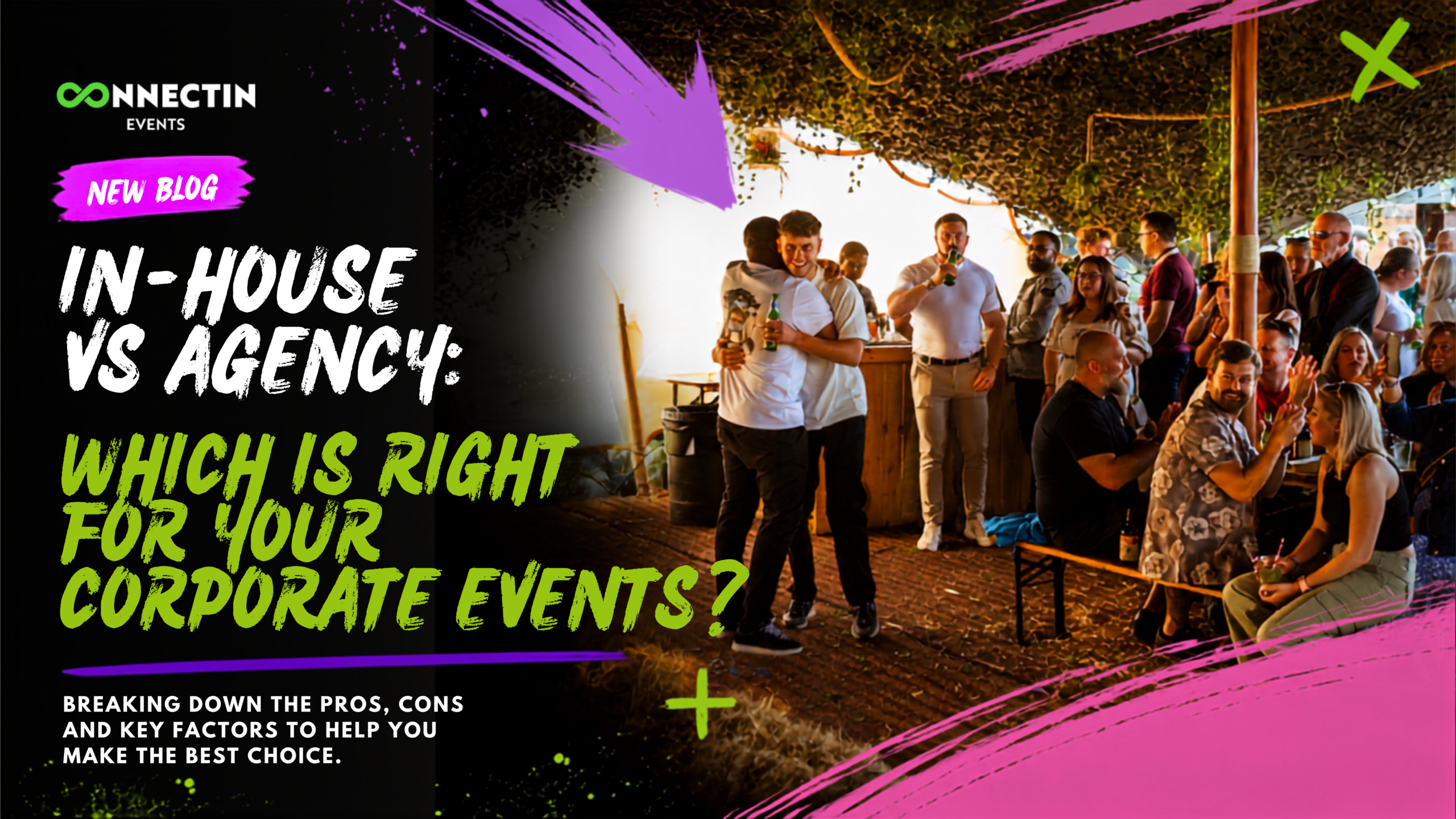
Should you build an in-house events team or hire an agency? For most businesses the honest answer is an agency, because you only pay for event expertise when you actually need it. But that is not the whole story. If you run events constantly, in-house can make sense, and plenty of companies land on a mix of both. Here is how to decide, without the sales pitch.
What in-house really costs
An in-house events manager looks cheaper than an agency day rate until you total the real cost: salary, employer costs, software, training and the quiet expense of supplier rates negotiated once a year instead of every week. One person can plan brilliantly, but they cannot be a producer, designer, AV technician and venue negotiator at once, so for bigger events you end up hiring those skills anyway. And when your events manager is on leave the week of the conference, the risk is all yours.
What an agency actually gives you
Three things you cannot easily build internally:
- Buying power. Agencies book venues and suppliers every week, so they get rates and priority that a once-a-year buyer will not. A good venue finding service often saves more than it costs before the event work even starts.
- Scale on demand. One point of contact, but behind it a full team: planning, production, design and crew, sized to the event rather than the payroll.
- Pattern recognition. An agency has already solved the problem your event is about to throw up, because they hit it last month on someone else’s event. That experience is what stops small issues becoming visible ones.
When in-house is the right call
Build internally if events are core to your business model, you run them monthly or more, the formats repeat, and you can keep a team genuinely busy year-round. Internal teams win on brand knowledge, speed of internal sign-off and day-to-day availability. Exhibition-heavy businesses and membership organisations with constant programming often fit this profile.
When an agency is the right call
Go agency if events are important but occasional: an annual conference, an awards night, a product launch, a summer party. You get senior expertise for the weeks that matter and pay nothing for the months that do not. It is also the right call when the event is high-stakes and unfamiliar, because the cost of learning on your own flagship event is brutal.
The hybrid model most companies actually use
In practice, many businesses keep event ownership in-house (one person who knows the goals, the brand and the stakeholders) and bring in an agency for delivery: venue, production, suppliers and the on-the-day run. That pairing works because each side does what it is best at. The internal owner steers, the agency executes, and nobody is stretched past their skill set.
The cost comparison, honestly
A full-time events manager in the UK typically costs a mid five-figure salary plus overheads before a single event is delivered. Agency support is priced per event, typically from a few thousand pounds for a smaller event up to six figures for a large production, as covered in our corporate event cost guide. If you run one to four significant events a year, the agency route almost always comes out cheaper for a higher standard of delivery. Above that, do the maths on your actual calendar.
How ConnectIn fits
We work both ways. Some clients hand us the whole thing; others have an internal owner and use us as the delivery engine: corporate event management, live events, production and venue finding under one roof. Either way you get one team, transparent pricing and zero stress landing back on your desk.
Frequently asked questions
Is it cheaper to plan a corporate event in-house?
Only if you already employ the skills and run events often enough to keep them busy. For occasional events, the true in-house cost (salary, overheads, weaker supplier rates and your team’s time) usually exceeds an agency fee, and the delivery risk is higher.
What does an event agency do that we cannot do ourselves?
Negotiate better venue and supplier rates, bring specialist production and design skills, staff the event properly on the day, and apply experience from hundreds of previous events to stop problems before they happen.
Can we use an agency but keep control of our event?
Yes, and it is the most common setup. You keep ownership of goals, brand and budget; the agency handles delivery and reports to you. A good agency feels like an extension of your team, not a replacement for it.
How do we choose the right event agency?
Ask what is included, who runs your event on the day, and for recent comparable examples. Clear pricing and calm, specific answers are the tell. We have a full guide on how to choose an event management company.
Weighing it up for a real event?
Tell us what you are planning and we will give you an honest read on the best setup, even if that is not us. Get in touch with ConnectIn Events.
Share this post
Related posts